An Interview with Jon Jandai and Janell Kapoor
The Natural Building Colloquium is an annual gathering of builders and teachers from around North America and beyond. This year’s colloquium took place in October at a camp in southern Oregon. One of the most exciting presentations was by Jon (pronounced “Jo”) Jandai from Thailand and Janell Kapoor of Kleiwerks in North Carolina, who presented their recent work teaching earthen building in Thailand. Following their slide show, Michael G. Smith of the CobWeb, Margie Bushman of Hopedance Magazine, and Joseph Kennedy of Builders without Borders sat down with them to ask some questions.
Q: Let’s start by asking Jon about your background: who are you and how did you become interested in earthen building.
JON: The first thing is, I wasn’t interested in building at all. I think about self-reliance, so I go back to become a farmer. And then, to become a farmer is not enough to become self-reliant. I have to learn to do everything that I need. So I have to learn about building. Then I have a chance to visit Taos Pueblo in New Mexico, and I like it a lot. When I went back home, I start to build. I feel like it’s very easy to build a house. Before that I worry a lot about the house – it’s a big thing I can’t get easily. But the first adobe house was easier than I thought it would be. And after that I build a house almost every year – at least one building per year.
Q: What was your job before you went back to farming?
JON: I work in a hotel in Bangkok, and some time in a factory.
JANELL: Jon was also a monk.
Q: Does Thailand have a tradition of earthen construction?
JON: We have some, but we don’t use it for housing, only for grain storage. It’s wattle-and-daub style, but normally they use cow dung, not mud.
JANELL: I saw a few horno-style ovens that looked like they were made from earth.
JON: We make charcoal, and use mud for making charcoal ovens. That’s the only way that people use mud in Thailand.
JANELL: Not too long ago Thailand was mainly jungle. It’s been greatly deforested. The traditional building material was hardwood, as well as thatch and bamboo, which don’t last a long time. In the last several decades, it’s been just concrete all over. There’s very little hardwood left and people can’t afford it, not to mention the ecological implications.
Q: So is housing a major expense for people in rural areas?
JON: In rural areas, it’s a little bit expensive. Normally, their income might be four hundred dollars per year per family. To have one house of concrete and wood, it costs about four thousand dollars. That’s their entire income for ten years, not to mention their other expenses. And if you are in the city, it costs far more than that. More than thirty years you need to work to get one house.
Q: So you returned to Thailand after seeing Taos Pueblo, and decided to build yourself an adobe house. Tell me about that process.
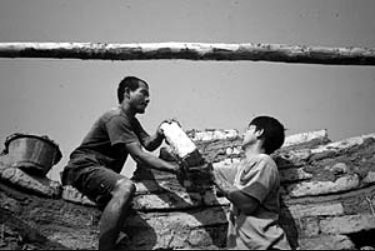
JON: When I went back home, I start to experiment with adobe brick. After I make a test, it’s very strong and I feel more confident. People come and say, “you’re crazy! How can you build house with mud?” But after they saw the way of building, they understand it and accept it. Now there’s two people in the village who built their house of adobe. And then they start to build the temple in my village with mud, too.
Q: Janell, how did you get to Thailand and how did you get involved in earthen building there?
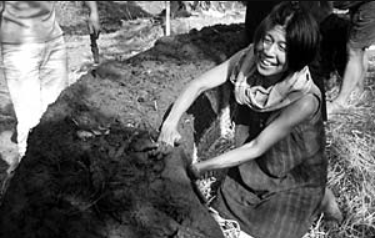
JANELL: I was with a friend who was doing seed saving in Thailand. He was riding his bicycle, staying in villages, collecting hundreds of varieties of rice. I spent some time there with him. . While there we visited an island. We were out snorkeling on a little boat, and the people sitting behind us intrigued me. I started talking with them, and the man turned out to be the head of an Ashram, which is more an activist training center than a spiritual retreat place. I told him what I do and he invited me to come teach a cob workshop, and I said, “of course.” I went the following winter. None of us really knew what to expect. In the end there was a tremendous response. Every day there were more and more people interested. It felt really good to be invited to share something of interest and value to people there who were doing community organizing. The intention was that they would invite representatives of various organizations that they were working with to be at the training, and then those people would go back to their regions of Thailand and other parts of Southeast Asia to do the same. We designed the course so that we could actually finish the project in the time that we were there – that was really important.
Q: What was the project?
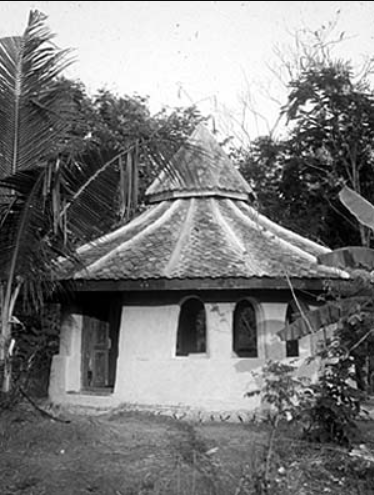
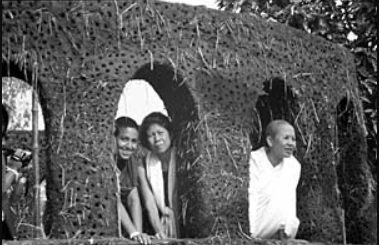
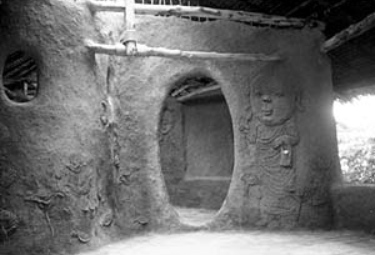
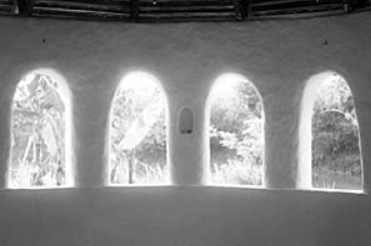
JANELL: We built a small meditation space. It was a seventeen foot diameter exterior, with fifteen arches. It was important to design something that would look good and that was strong and stable, because it was a model that many people would come to see. And because it’s so new there. My mantra was, “make sure we can complete it.” Another goal was that when we left we weren’t needed any more. We would work with a team of folks who would continue without us. And that’s exactly what happened – more than we could have imagined. That’s where we met Jon. Because of all the interest, we stayed on and worked together with Jon. We did a second course and focused on adobe building, which seems more relevant. Thailand is not a seismic area. Building with adobe is faster and easier. It’s plenty strong. So the majority of earthen building that’s happening there now is adobe and wattle-and-daub, along with experiments and hybrids. From those two courses, and because of the activist network which exists, hundreds and hundreds of people have been involved in trainings that have continued to happen since we left.
Q: This is all just in the last year:
JANELL: Yes, we were there in January for the first course. Then we did one in March. Then there were three more months until the monsoon started. Poor Jon, the day he gets back to Thailand he has no recovery time from jet lag because he’s getting off the plane and going straight to another building project. Between monsoons there’s building ongoing with different communities in different parts of Thailand.
Q: Jon, how do you explain the response, the enthusiasm? It sounds like there’s huge receptivity to earthen building in Thailand.
JON: I feel like there’s too much response. A lot of people interested. I give up. I’m going into hiding. I try to not tell people my phone number, because people call me all the time. It’s good that we build one structure at the Ashram and one in Bangkok, so I can tell them to contact those two places.
Q: Why do you think so many people are interested?
JON: Because of the economic collapse. That helped a lot. Before that, I built adobe houses in Thailand for five years, but very few people interested.
Q: What was the economic collapse caused by?
JON: The IMF says because of poor management. Thailand was the first country in Southeast Asia to collapse, and after that Malaysia and Indonesia and Philippines, like dominoes. Every country in that region is in the same situation: a lot of debt to the IMF and World Bank. In Thailand, the majority of the people live in rural areas. Most people are farmers, like seventy percent. But after they finish their rice farming, they will move to Bangkok to work seasonally. So the economic collapse didn’t effect them much, because they have rice at home. Maybe fifty factories closed in one month. They just went back home. There is no protest.
Q: How else do you explain the interest in earthen building?
JON: Another factor is the media coverage, which helped a lot. After the workshop, news spread very fast on every kind of media – TV, radio, newspaper, magazines. And then people all over the country contact us. We’ve tried to focus on groups of people who want to learn together. If some people contact us who just want to build their own house, we don’t want to talk to them.
Q: You want to teach teachers, is that what you’re saying?
JON: We want to help with the learning process of the community, when many people learn together.
JANELL: Maybe out of the trainings will come people who will build for hire, but the focus of Jon and the group at the Ashram is the grassroots level, the community movement, the social change potential. It’s a really different intention.
Q: What’s the relationship between earthen building and community development? How is earthen building helping to strengthen the communities that you work with?
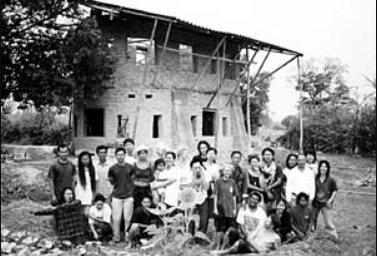
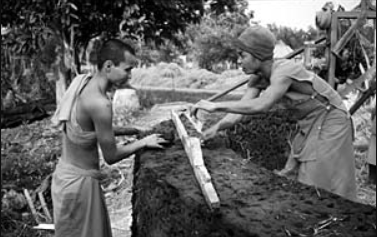
JON: It’s the way to solve their problems now. They want to solve their problems, and they want to do it together. With adobe, if a lot of you build together, it’s faster and more fun. It’s the old tradition that we have almost lost now, because people have to work for money. When they work for money, they will not work together like that. But now we take back the old tradition to work together and help each other. If five people each want to build a house, they all build this house together and then move to another house, then another.
JANELL: When you were young, how was it?
JON: When I was young, I don’t feel like we are working. Everything is fun, like a party all the time, even when we’re planting rice. Today, I will plant my rice. Another family will come to my farm. They bring food, eat together, work together. In one day we finish a big piece of land. And the next day, another family will say, “Oh, I want to build my house.” We go cut wood together, build a house, and do everything together. Because we don’t use money. The first time I use money was when I was nine years old. There was nothing to buy – that’s why we don’t have money. But now, thirty years later, it changed very fast. Now, nobody even tells the old stories, nobody is even joking any more. And nobody can play musical instruments like before, because everybody has to work to make money. Now we feel like we work harder, but we do not get anywhere. The more we work, the more we go in debt. So we want to go back to the old path.
JANELL: And luckily in Thailand, they’re not far from it. Jon is young and still has that memory. And I want to say that I’ve never been around people who have more fun, so I wonder what it must have been like when you were little. By contrast to here, people are constantly joking and laughing all the time.
JON: One thing I’ve noticed. Before, people have no privacy. In one house, people stay together in only one room. Even a big family – nine or ten people. But now in the new era of consumerism, we start to have privacy. And when we start to have privacy, the sense of community disappears immediately. The families become smaller and smaller. Parents have no time to be with their kids. We are destroying community very fast now, because the idea of privacy came to the society. Privacy doesn’t help anything. It creates your ego only, and makes your own walls bigger. It’s hard for another person to get inside you, to understand you. So I don’t know what will happen in the future.
Q: Talking about the future, it sounds as if in a very short period of time, the work that you two have done has created a huge amount of momentum and interest. Do you have any sense of where that’s going, of what might happen next?
JON: In the future I feel like we have more hope that we can solve the problems in society better. The benefit of the economic collapse six years ago is it made people turn to natural building more, turn to organic farming more. Before economic collapse, I talk a lot about organic farming, I tried to set up a group, but I cannot get anybody. But after that, I did not work hard at all. People just come. And now my group has two hundred people to grow organic farming. We can see the difference really clearly. One good thing from globalization is we can get information from outside more. We learn more from the experience of Argentina, of Mexico, of other countries.
JANELL: This winter, in November, we’re going to be working with a community that was displaced from their land by World Bank-funded dam projects. They’re one of the most well-known people’s movements in Thailand, very high visibility as far as media coverage. They’re going to be living and modeling a self-reliant village. Part of that is going to be building their houses out of earth. For the whole month of November there’s going to be hundreds of people joining to help build their village. We’re going to build twenty-one houses, two saunas, a granary, and a community building, mostly out of adobe. The villagers have already been growing pretty much all of the food that we’re going to be eating. They’ve canned bamboo shoots, they’re growing the rice and the vegetables. There has been coverage of this project in something like twelve major magazines in Thailand as well as TV and radio shows, so the word is spreading very fast. I think it’s going to make a strong impact – more than what we might be able to imagine now, even though there’s already been such incredible results.
JON: Some government officials, like the Thai tourism department and the housing department, are interested to support us with this project. We think a lot about whether to use tourism to promote our projects, because it will effect the lives of the villagers there. If a lot of people come to that village, what will happen to their lives in the future? So we hesitate about that.
Q: So both of you will be involved in the village construction? That’s exciting. Are there other people involved besides the two of you who are experienced in earthen construction?
JANELL: For now, not many people who are experienced – a small handful. But there’s also the common sensibility of the villagers themselves, who know the earth. It’s impressive to go from this country where most of us who are drawn to the Natural Building movement didn’t grow up in that natural environment. In Thailand, it’s such a contrast. People just get it. They are adventurous and experimental in figuring things out. They have an innate sense of how to build.
JON: Another thing is we don’t have a history of clay building in Thailand. That helps a lot, because in other countries, like India, Nepal, China, or South America, they’re used to having it. So if somebody does something like that they consider it poor. But in Thailand we don’t have that stigma, it’s something new, so they want to try it.
JANELL: Thai people love whatever is cutting edge. There’s a real creative spirit. Knowing that people can sculpt their houses and not have to live in square boxes certainly drew attention. Maybe not from the villagers who are more focused on practical utility, but it definitely got the middle-class excited. I also think perhaps having foreigners involved has helped it take off because there is still an emulation of countries with more money. And finally, there’s a feeling of something beyond what we might be able to comprehend through our reason, something magical. I kept feeling that something bigger was happening – something ripe and ready. There’s a group Jon’s working with called Santia-shoka, which means “peace and happiness” which is a very widespread movement with several hundred thousand people throughout the country who are looking at the opposite of capitalism, creating a giveaway system based on Buddhist principles of love and abundance. They have been doing trainings in self-reliance, farmers and villagers helping each other get out of debt. And part of the trainings now include earthen building. The stage is set.
Q: Is there a way that those of us in the developed world who have access to a lot of resources and information can help? What kind of involvement, resources, or support are you looking for from countries like this one?
JON: All kinds of information we need a lot now. We need examples to show people that it’s not something new; it’s something that people have done for many generations; it’s safe and stable and lasts very long. We need pictures to show people, “here is an earth building, adobe or cob building, four hundred years old.” That can help a lot, especially the elite of the country, like the architects, who don’t know anything about this. If they get the information, they will understand it. They will pay more attention.
JANELL: Jon gave a talk in front of the Board of Architects in Thailand. There were two hundred architects and professors of Architecture. He had nothing to show them, and they were still interested. But having visual aids, a slide show, books from all over the world showing that earthen building is a long tradition in many places. That is one big request. The other is for video equipment to document our work and share it with other groups around the country.
Q: Where can people who are interested in supporting you with resources or getting more information contact you?
JON: They can contact me at the Pun Pun organic farm www.punpunthailand.org or pareents@yahoo.com.
JANELL: And I’m the contact in this country: janell@kleiwerks.com or www.kleiwerks.com.
Q: Thank you both so much for your work, and for sharing it with us.